Relational architecture
Model customers, orders, inventory, assets, and other business entities with appropriate keys, constraints, relationships, and transaction boundaries.

Database development
When records disagree, queries slow down, or a new feature strains the schema, the solution needs more than another table. We design and evolve databases that preserve business meaning, support demanding workloads, and make change manageable.
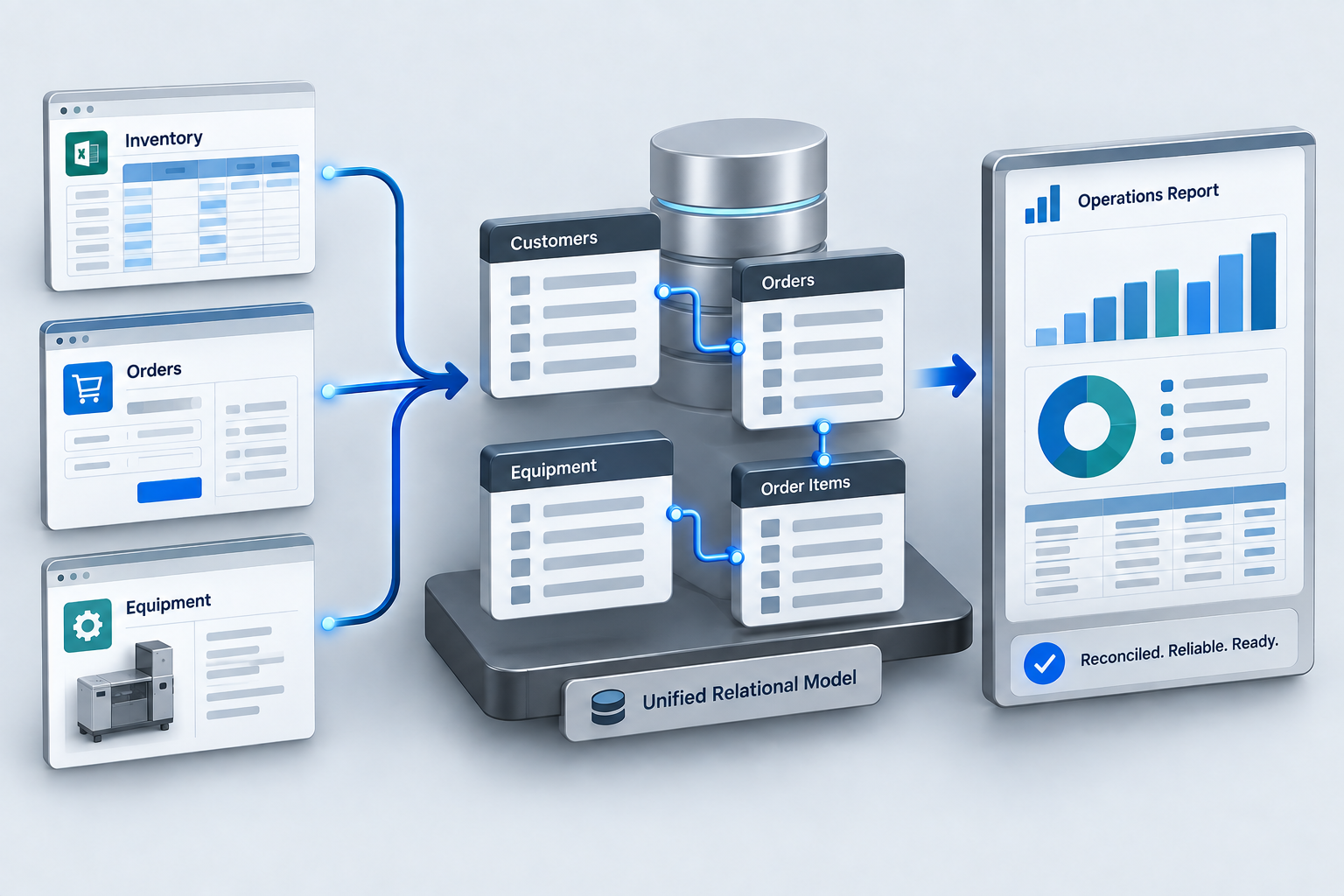
Where we can help
Start with a focused improvement or connect several capabilities into a larger solution. The scope follows your priorities.
Model customers, orders, inventory, assets, and other business entities with appropriate keys, constraints, relationships, and transaction boundaries.
Implement complex rules using readable, set-based SQL, window functions, interval logic, and deliberate aggregation. Use explicit columns and deterministic ordering where results depend on sequence.
Investigate execution plans, cardinality estimates, reads, and workload patterns. Balance targeted indexes with write costs and validate improvements against representative data.
Bring data from applications, files, and APIs into consistent structures. Handle duplicates, late arrivals, rejected records, and reconciliation totals explicitly.
Plan versioned schema changes, data backfills, compatibility windows, and rollback or recovery steps so a release can move forward predictably.
Create dimensional models, reporting views, and transformation pipelines that separate operational complexity from consistent business measures.
Define validation rules, ownership, lineage, and exception handling. Make it possible to trace a reported number back to its source and transformation.
Protect multi-step updates with appropriate isolation and error handling. Design for concurrency, retry behavior, and idempotent processing where repeated requests are possible.
An example workflow
For an equipment rental business, reservations, active rentals, and maintenance may overlap. A carefully designed query can reconcile those intervals without double-counting and explain which assets are truly available.
Define the time window, eligible assets, and treatment of overlapping commitments.
Normalize intervals, resolve conflicts, and aggregate at the correct grain.
Test boundary cases and compare totals with independently calculated expectations.
Built with care
A reviewed data model, versioned database scripts, documented business rules, meaningful validation cases, and workload-specific performance findings.
Make null handling, date boundaries, decimal precision, and tie-breaking explicit. Complex SQL should remain readable enough to review and support.
Use sargable predicates where possible, project only needed columns, and measure execution behavior. Avoid blanket hints or indexes without workload evidence.
Include migration scripts, permissions, observability, and meaningful regression cases alongside the schema and query code.
Explore the work
Interactive browser samples with fictional data illustrate workflows and problem-solving approaches. Production platforms and integrations are scoped for your project.
A useful starting point
Bring a schema or data dictionary, representative queries, expected volumes, and examples of results that are slow, inconsistent, or difficult to explain.
Discuss database development ↗Opens a draft in your email application.